Widespread poisoning and contamination in the town
Fever DreamWidespread poisoning and contamination in the town are revealed not as one clearly diagnosed incident but as a pattern that reaches water, animals, and children. Residents encounter the danger through practical warnings and unexplained illness, while inadequate medical care and uncertainty leave families to interpret the evidence themselves. The pattern’s decisive significance is its scale: the poison was already present before any one family could recognize it, and its effects cannot be contained within a single household or a single episode.
Water and the First Warnings
When Amanda and Nina arrive at Amanda and Nina’s vacation house, Carla approaches carrying two empty plastic buckets and asks whether Amanda has noticed that the water smells different. Carla has gone to fetch water and insists that Amanda should not use the tap that day. Her warning is specific and actionable, but its basis is not explained: Amanda has only just arrived and cannot tell whether the smell is abnormal. They drink iced tea together outside, near the pool, while Carla mentions the butter cookies she would have made to accompany it. In retrospect, the ordinary hospitality of this first meeting is set beside an early sign that the household’s water may not be safe.
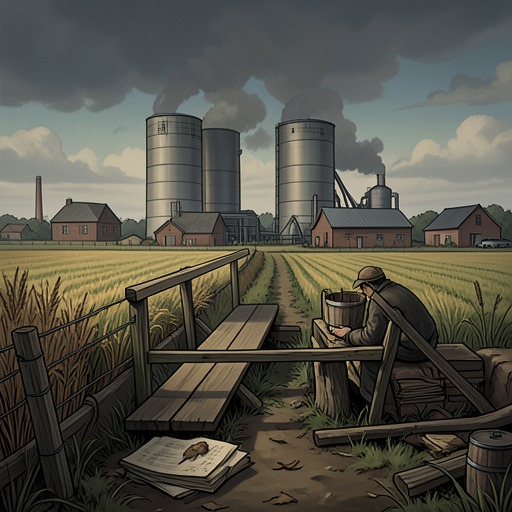
The story later supplies a more alarming instance of contact with water. Carla recalls finding David at a stream after he had knelt beside it and put his hands in the water. A dead bird lay nearby. The next morning, the borrowed stallion that David had been near was gravely ill, with swelling that changed its appearance and left it weak. Carla feared that her son had drunk the same water and believed he might be in immediate danger. The episode establishes a disturbing association among the stream, an animal’s sudden illness, and David’s exposure; it does not identify a substance or prove a medical cause. Carla’s terror arises from the pattern she thinks she recognizes, not from a diagnosis.
Animals and the Accumulating Signs
The poisoned stallion is not the only animal loss connected to Carla’s account. Omar wakes her before dawn with the news that the horses are missing. Their disappearance follows an earlier period in which David sometimes vanished from the house at night, prompting Omar to search for him and eventually to lock him in his room. On the morning the horses are gone, David’s door is open, as is the front door. A four-month-old foal remains alone in the pasture, motionless while Omar searches the fields and the direction of the stream for the others. The surviving foal and the absent horses make the scene an unresolved warning rather than an explanation.
The accumulating animal cases broaden the significance of the town’s suspected contamination. Carla later connects the deaths of the horses, the dog, and the ducks with the children in the clinic’s waiting room and with the boy who now lives in her house but is no longer her son. This is Carla’s interpretation of related events, and the narrative does not establish that each animal’s fate has been conclusively traced to one source. Still, the recurrence matters: illness and loss appear across different households and kinds of life, making the danger difficult to dismiss as one family’s isolated misfortune.
Exposure and the Missing Diagnosis
The book presents several possible routes of exposure without resolving them into a toxicological account. Water is an explicit concern from Carla’s first warning and the stream episode. Later, David describes children who may have been poisoned by something their mothers breathed in the air, ate, or touched. This account distinguishes children who experience poisoning episodes from those who, in his understanding, were born already poisoned. It suggests that exposure can precede a child’s own remembered or visible illness, while leaving the responsible agent and the timing uncertain.
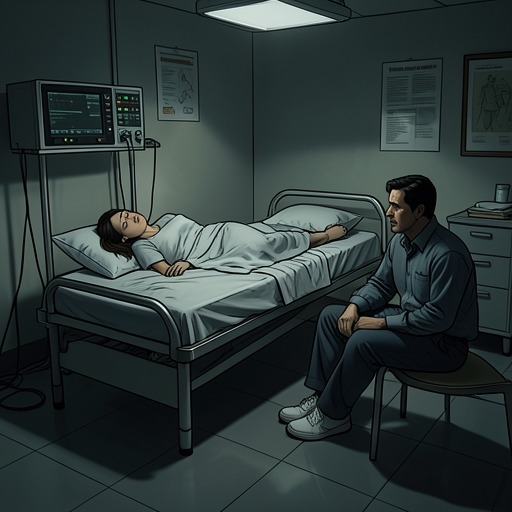
The clinic’s response underscores the distance between symptoms and recognition. When Amanda and Nina seek help, the medical worker attributes their condition to too much sun, advises rest, and gives each of them a pill and a cup of water. Amanda later understands that they have been poisoned, while the treatment is for sunstroke. The episode does not name the medicine or identify the contaminant; instead, it shows how a familiar diagnosis can misread a more serious danger. The mismatch leaves the family with no reliable explanation from the place they turn to for care.
That failure is part of a wider shortage, not merely a single mistaken judgment. Carla says there are no doctors in the area, and that the woman in the Green House does what she can. Earlier, Carla explains that local people sometimes seek this woman’s help because doctors called to the clinic take hours to arrive and, in residents’ view, do not know how to help in serious cases. The community therefore relies on informal knowledge and alternative care as well as on a clinic that cannot provide timely, dependable answers. Such improvisation may offer a response when formal care is unavailable, but it does not amount to a confirmed account of what is making people ill.
Children and the Scale of the Threat
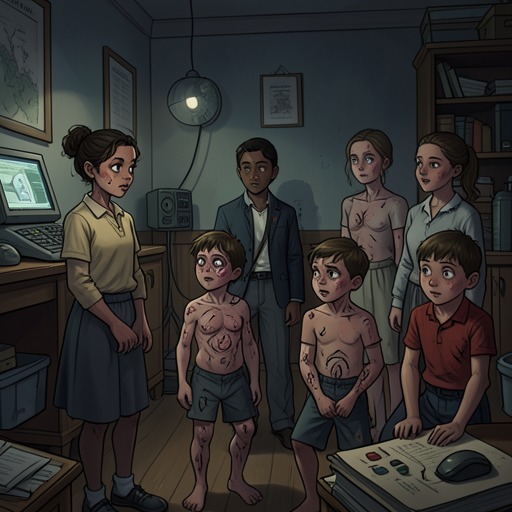
The waiting room gives the crisis a collective and unsettling human scale. David says there are thirty-three children there, though the number changes. He describes many as visibly different, while noting that only a few appear like Nina. The text does not establish the cause of each child’s condition, nor does it reduce their differences to a single diagnosis. Their presence nevertheless alters the meaning of Amanda and Nina’s illness: the question is no longer only what happened to two visitors, but why so many children in the area may be affected.
David’s account extends that uncertainty to birth itself. Some children, he says, were born poisoned through what their mothers breathed, ate, or touched; others undergo poisoning episodes later. The statement makes exposure seem both ongoing and difficult to observe, with potential consequences that may be present from birth or emerge as episodes of illness. It remains an account within the narrative rather than a formal public-health finding. Its importance lies in the contrast between the children’s repeated presence and the lack of doctors able to explain their condition.
Responsibility and Narrative Significance
When Amanda collapses, Carla comes to see her after seven hours and interprets the crisis as connected to the children in the waiting room, the animal deaths, and the altered boy in her home. She also blames herself, wondering whether moving Amanda from one body to another changed something small and invisible. The explanation shows how a community-wide danger can be experienced as private responsibility: without dependable diagnosis or a known source, Carla turns the consequences back on her own actions. The narrative explicitly rejects her self-blame as the true explanation, while withholding a complete account of what the danger is.
Amanda’s questions similarly circle around whether the poison is everywhere and whether she has done something wrong as a mother. The answer that the poison was always there shifts the emphasis away from a sudden, isolated mishap. Contamination becomes a condition that precedes recognition, while the characters encounter it through delayed warnings, sick animals, children’s symptoms, and inadequate care. The town’s crisis is therefore both environmental and social: exposure is suggested across water, air, food, and touch, but the people most directly confronting its effects lack clear information and timely medical help. The evidence supports a pervasive threat and its unequal burden on families and children; it does not establish a particular chemical, a definitive source, or a complete account of responsibility.